


Blog
What to Consider When Choosing an OEM Crankset for E-Bike Mid-Drive Motors?
Mid‑drive e‑bike motors put a very different kind of stress on cranksets than a regular pedal‑only bike. Because the motor output power directly into the drivetrain, the crankset isn’t just turning pedals — it’s taking constant, sometimes jerky bursts of torque. Picture the little jolt when you roll away from a stoplight with a commuter pack on your back, or the steady, teeth‑grinding pull on a muddy, 15% climb. The arms and spider have to stay true through thousands of those start/stop cycles, repeated heavy accelerations and the small, nagging forces of everyday use.
That changes what you must demand from a crank: strength, stiffness and fatigue resistance aren’t optional extras — they’re fundamentals. For manufacturers and drivetrain suppliers shopping for an OEM crankset, “will it fit the motor?” is only the opening note. You also need to think, practically and physically, about crank arm length and shape (how they change pedaling feel and clearance with pedals or panniers), materials (aluminum alloys, steel or carbon — each brings its own weight, durability and failure modes), and the structural layout that dictates where stress concentrates: spindle interface, spider arms, chainring bolts. Those small, easy‑to‑overlook details like chainline and Q‑factor matter too — they affect shifting crispness, knee comfort and how the bike behaves when you’re standing and hammering.
Beyond the metal and geometry, the real world creeps in: what kind of fatigue and bench testing has the crank seen, how many cycles did it survive, and what did field testing look like — salt spray, mud, luggage, repeated hard launches? What tooling does production need, how long will lead times be, and can the supplier scale or tweak the design to your specs without blowing the schedule or the budget? In short, choosing a crankset for a mid‑drive e‑bike isn’t just about a part that fits the splines. It’s about finding a partner whose engineering choices, testing regimen and manufacturing capacity actually match the harsher, more dynamic life those components will live.
So, what should you look for when choosing bicycle crankset manufacturers for an E-Bike mid-drive application?
1. Check Mid-Drive Motor Compatibility
The first step is confirming suitable spider and chainring for different brand of motor drive system such as Bosch, Bafang, Shimano, LDS, Avinox…etc.
Different E-Bike motor systems may have different requirements for Spider. and axle length, these factors are critical for chainline.
Q-factor is another key design consideration that requires a balance between motor compatibility, chainline, frame clearance, and rider ergonomics.
Before starting an OEM project, the Project Manager needs to provide your supplier with motor specifications, interface dimensions, engineering drawings, crank length requirements, chainline requirements, and other relevant technical information.
Experienced bicycle crankset manufacturers LASCO can review these requirements during the engineering stage and identify potential compatibility issues before tooling and mass production begin.
This early engineering review can reduce unnecessary modifications and help shorten the sample-development process.
For customized OEM/ODM E-bike cranksets, motor compatibility should be one of the first technical considerations discussed with LASCO.
2. Evaluate Torque and Load Requirements
Mid‑drive motors can subject a drivetrain to surprisingly large, repeated shocks — the kind you feel when you stomp the pedal to sprint, grind up a steep climb, or keep stopping and starting in town.
Because of that, an e‑bike crankset has to hit a careful balance: enough strength and durability to survive those hits, while still keeping weight and manufacturing cost in check. Crank length and arm geometry matter too — they change the leverage and where loads end up — so you can’t design a crankset by material spec alone. When you’re evaluating manufacturers, ask how they simulate real-world loading: LASCO follow the ISO 4210 and EN15194 Electrically power bicycle assisted cycles(EPAC) And if you’re ordering a customized OEM/ODM crankset, get the testing plan and acceptance criteria sorted before the design is finalized.
3. Consider Material and Crank Arm Construction
Material choice sets the baseline for a crankset — it governs strength, weight, longevity, looks and, not least, production cost. Aluminum alloys are the common choice because they offer a practical mix of lightness and structural performance. Still, the metal is only one chapter of the story.
Arm geometry and cross-section, whether you forge, cast or CNC the part, the heat treatment, the surface coating, and the precision of the machining and finishing all shape the final behaviour of the crank. A cleverly shaped, thin-walled aluminum arm can outperform a bulkier design made from the same alloy, and a glossy anodize won’t fix tolerances.
For OEM projects, brands do better to discuss the entire manufacturing chain with their supplier instead of choosing a material from a spec sheet and calling it a day. Experienced crankset manufacturers can help map material, design, process, performance requirements and target cost — advice that becomes especially valuable when you’re creating an OEM/ODM crankset for a new e‑bike platform..
4. Check Chainline and Q-Factor
Chainline is one of those small measurements that quickly becomes obvious when it’s wrong — a crooked chain makes noisy, clumsy shifts, saps pedaling efficiency, and wears down chainrings and rear sprocket faster than you’d expect. On a mid‑drive e‑bike the crankset part of transmission device: it has to mesh cleanly with the motor’s output, the chainring, the rear sprocket, the rear wheel and the frame’s dropouts. Get any of those offsets wrong and the whole drivetrain feels sloppy.
Q‑factor matters in a similar, but more human, way: it’s the lateral distance between the left and right crank arms. and can change how your feet track, how comfortable your knees feel, and how the whole bike pedals. The right Q‑factor depends on the frame, the motor system, the crank arm design and the rider’s stance, so it’s not a one model crank arm fits all number. During the engineering phase, LASCO able to run the dimensions against the motor and frame geometry and tell you if an off‑the‑shelf crank arm will do or if you need a custom design. That conversation — defining chainline and Q‑factor before tooling starts — is exactly why working with experienced crankset manufacturers pays off when you’re developing an OEM/ODM e‑bike model.
5. Decide Between OEM and ODM Crankset Development
Not every E-Bike brand requires the same level of customization.
OEM Crankset Manufacturing
With OEM manufacturing, the customer generally provides the product specifications, engineering drawings, dimensions, materials, performance requirements, and other design information.
The manufacturer then produces the crankset according to the agreed specifications.
OEM can be an effective solution for brands that already have a completed product design and want to outsource manufacturing.
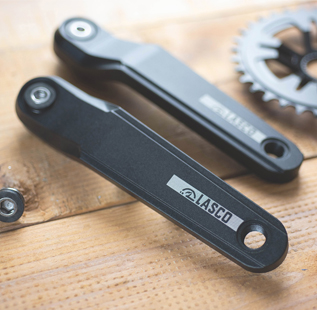
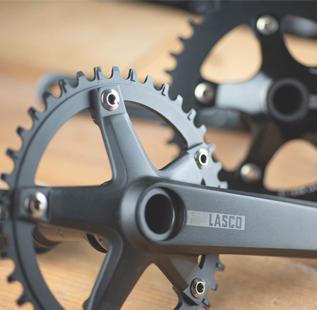
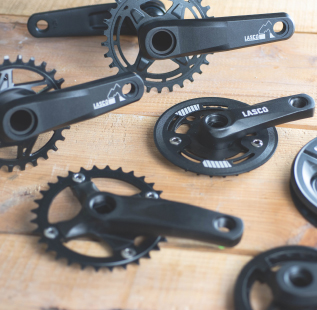
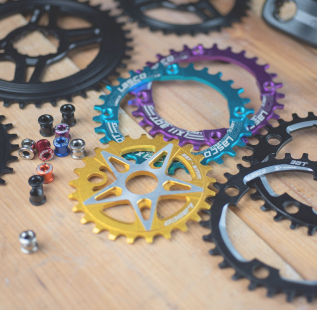
Besides mentioned above, one of the greatest benefits of OEM customization is the ability to place the customer’s brand logo directly on the crankset. LASCO can place customer’s logo through laser engraving machine, customers can determine the logo placement according to their design and branding needs, turning the crankset into an effective branding element and maximizing marketing exposure.
ODM Crankset Development
ODM provides a greater level of engineering and product-development support.
If a company has a product concept but does not yet have a complete engineering design, an LASCO may assist with product development, engineering evaluation, tooling, prototype or sample development, and production preparation.
For companies with limited internal engineering resources, LASCO can provide a more integrated approach to product development.
Brands should therefore determine whether they need straightforward OEM manufacturing or a more complete ODM development service before selecting their supplier.
6. Review Tooling and Sample Development
Customized cranksets may require new tooling or modifications to existing tooling.
Tooling requirements can directly influence development time, investment, and production planning.
As a rough guide, producing a sample using modified, existing tooling usually takes about 15 days, while starting with brand‑new tooling tends to run closer to 40 days. After the sample is approved, mass production commonly requires around 30–45 days. Those are ballpark figures — in practice they can shorten or stretch out depending on several factors.
Actual lead times hinge on things like product complexity (a simple aluminum crank is very different from a multi‑piece carbon design), how much tooling needs to be made, the number and rigor of testing cycles, order quantity, material availability, and where your job sits in the factory schedule. Even small things — a delayed alloy shipment or a holiday shutdown — can add weeks to the calendar.
When you compare bicycle crankset manufacturers, ask for a clear, step‑by‑step development timeline that spells out engineering review, tooling, sampling, testing, approval, and mass production, with milestone dates rather than vague promises. For an OEM/ODM crankset project, lock in the tooling plan at the outset — doing that up front is one of the simplest ways to avoid the kind of unexpected delays that end up costing time and money.
7. Ask About Quality Control and Product Testing
Quality control is an important factor when selecting an OEM crankset supplier.
A reliable manufacturing process should include appropriate quality checks from incoming materials through machining, forming, finishing, assembly, and final inspection.
Depending on the product and application, quality control may include:
- Dimensional inspection
- Material verification
- Torque testing
- Static load testing
- Fatigue testing
- Surface and finish inspection
- Crank arm geometry inspection
- Interface and assembly inspection
- Final product inspection
E-Bike cranksets require particular attention because the crankset operates as part of a larger system involving the motor, drivetrain, frame, chainring, and rider.
LASCO follow the EN 15194 is the official European Standard that specifies the safety, performance, and testing requirements for EPACs (Electrically Power Assisted Cycles), commonly known as e-bikes or pedelecs. First introduced by the European Committee for Standardization (CEN), it ensures that electric bicycles meet strict quality and safety criteria before they can be sold in the European Union (EU).
LASCO follow ISO 4210 is an international standard established by the International Organization for Standardization (ISO) that specifies the safety and performance requirements for conventional bicycles. Unlike EN 15194, which focuses on electric bikes, ISO 4210 is the global baseline for testing the physical strength and mechanical safety of traditional non-electric bicycles.
When evaluating bicycle crankset manufacturers, ask what testing equipment and quality-control procedures are available and whether the manufacturer can support customized validation requirements.
A clear testing process can provide greater confidence before moving from samples to mass production.
8. Consider MOQ and Production Capacity
Product design is only one part of a successful OEM project. The manufacturer also needs to support your expected production volume.
MOQ can vary depending on the product design, customization level, tooling requirements, material requirements, and production process.
Production requirements may also differ between E-Bike, MTB, road-bike, urban-bike, and other crankset applications.
Before placing an order, discuss:
- Initial order quantity
- Expected annual demand
- MOQ requirements
- Production capacity
- Packaging requirements
- Delivery schedule
- Future product variations
- Additional crank lengths or configurations
When selecting bicycle crankset manufacturers, it is useful to evaluate not only whether they can manufacture your first order, but also whether they can support future production growth.
For brands developing an OEM/ODM bicycle crankset, this long-term capacity can be especially important. LASCO has fully production equipment and capacity to make crankset as request.
9. Look for Engineering and Customization Support
A good OEM supplier should offer more than just the ability to make parts. When you’re developing a crankset, questions pop up all the time — spindle diameters and interface tolerances, chainline and Q-factor, which alloy to use, whether to forge, CNC or mold, what tooling will cost and how long it will take, plus the right tests for fatigue and corrosion.
I’ve seen projects stall because a shaft dimension was assumed instead of checked, or because a cheaper material saved money up front but failed in endurance testing. Having an experienced engineering team on the supplier side turns those slow, costly back-and-forths into practical solutions: a quick sketch on a call, a proposal for a different heat treat, or an adjusted tooling spec that keeps performance and cuts cost. The LASCO team is always flexible and practical when it comes to handling these challenges.
That kind of collaboration matters even more for brands building a new e‑Bike platform rather than buying a standard crankset — the right manufacturer speaks both engineering and purchasing, translates requirements into manufacturable parts, and helps avoid needless redesigns so the product moves smoothly from concept to production.
10. Choose a Long-Term Manufacturing Partner
For an E-Bike brand, a crankset supplier can become more than a manufacturing vendor.
As your product line develops, you may need different crank lengths, finishes, interfaces, crank arm designs, chainring configurations, or completely new crankset models.
Working with LASCO provides both OEM and ODM capabilities can simplify future product development.
Established in 1978, LASCO has decades of experience in bicycle crankset development and manufacturing .You don't need to start a fresh supplier search for every single product — keeping and growing a solid engineering‑to‑manufacturing relationship pays off. Conversations get clearer, prototypes move through fewer iterations, and introducing a new crankset feels more like a planned step than a scramble. For that reason, brands should judge bicycle crankset manufacturers on things like engineering capability, customization experience, quality‑control systems, production capacity, and their ability to support long‑term OEM work, not just on price alone.
So what should you hand over to an OEM crankset maker? In short: the more technical detail, the better. Clear drawings or CAD files, material specs, expected tolerances, target volumes and timelines, testing standards — even photos or a reference sample — help a manufacturer size up feasibility, cost and delivery time much faster. Little specifics you think are obvious are often the ones that save the most back‑and‑forth.
What Information Should You Provide to an OEM Crankset Manufacturer?
To help the manufacturer evaluate your project efficiently, it is useful to provide as much technical information as possible.
Typical information may include:
- E-Bike motor model or motor specifications
- Crank length
- Axle or interface dimensions
- Chainline requirements
- Q-factor requirements
- Crank arm dimensions
- Material requirements
- Surface finish
- Target weight
- Performance requirements
- Testing requirements
- Estimated order quantity
- Annual production forecast
- Packaging requirements
Providing these details early allows bicycle crankset manufacturers such as LASCO to better evaluate the feasibility of your project.
For customers developing an OEM/ODM bicycle crankset, this information can also help the engineering team determine the appropriate development and tooling approach.
OEM vs. ODM Bicycle Crankset: Which Is Better?
The answer depends on your current product-development resources.
If your company already has complete engineering drawings and product specifications, OEM manufacturing may be the more straightforward option.
If you have a product concept but need assistance with engineering, design development, tooling, and samples, ODM may provide greater value.
| Requirement | OEM | ODM |
|---|---|---|
| Customer provides design | Usually required | Not always required |
| Custom dimensions | Yes | Yes |
| Engineering support | Depending on supplier | Usually more extensive |
| Tooling development | Available | Available |
| Sample development | Yes | Yes |
| Product concept support | Limited | Stronger |
| Best for | Established designs | New product development |
For many E-Bike brands, LASCO can provide a flexible path depending on how much engineering support is required.
Frequently Asked Questions About OEM Bicycle Cranksets
Q1. What should I look for when choosing bicycle crankset manufacturers?
Look for manufacturers with experience in crankset engineering, material selection, tooling, testing, quality control, OEM/ODM production, and mass manufacturing. Motor compatibility, chainline, Q-factor, crank length, production capacity, and customization capability should also be evaluated.
Q2. Can manufacturers develop a customized crankset for E-Bike mid-drive motors?
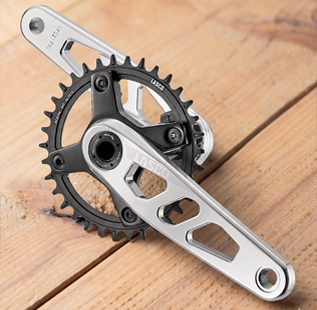
Yes. Depending on the manufacturer's capabilities, an OEM/ODM supplier can support customized crank arm dimensions, to create mold for new interfaces, chain ring style, crank lengths, crank style, and chainline requirements, Q-factor, materials, finishes, and other product specifications.
Q3. What is the difference between OEM and ODM bicycle cranksets?
OEM production generally follows customer-provided designs and specifications, while ODM typically provides additional product-development and engineering support. An OEM/ODM bicycle crankset supplier may support either approach depending on the customer's requirements.
Q4. How long does crankset sample development take?
A sample using modified existing tooling may take approximately 15 days, while new tooling may require around 40 days. After sample approval, mass production may typically take approximately 30 to 45 days. Actual lead times depend on product complexity, testing, order quantity, tooling, and production planning.
Q5. What testing should be considered for E-Bike cranksets?
Testing requirements depend on the application. Dimensional inspection, torque testing, load testing, fatigue testing, and other product-specific evaluations may be considered during development.
Q6. Can OEM crankset manufacturers support different crank lengths and specifications?
Many experienced bicycle crankset manufacturers can provide customized crank lengths, dimensions, finishes, interfaces, and other specifications depending on tooling and production capabilities.
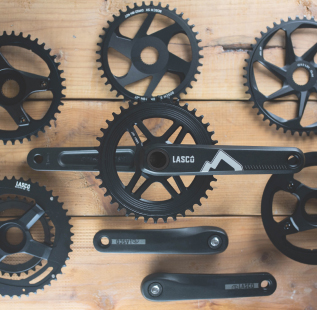
LASCO can offer wide range of crank length for different style of bikes. From 155~175mm, for kids bike, LASCO can offer shorter crank length from 90-130mm, depends on customer’s request.
Choosing an OEM crankset for an E-Bike mid-drive motor involves much more than checking whether the crankset can physically be installed.
Motor compatibility, torque and load requirements, material selection, crank arm construction, chainline, Q-factor, tooling, testing, MOQ, production capacity, and engineering support should all be evaluated before selecting a supplier.
The right bicycle crankset manufacturers should be able to support your project from technical evaluation and product development through sample approval and mass production.
For brands developing a customized E-Bike drivetrain, working with an experienced OEM/ODM bicycle crankset manufacturer can provide greater flexibility for product development and future model expansion.
By choosing a manufacturing partner with strong engineering, quality-control, tooling, testing, and production capabilities, E-Bike brands can build a more efficient path from crankset concept to reliable mass production.